

Tracking the Wholesale

Electricity Market


Get the energy data and market prices you need at a glance — or contact us to learn more. NRG tracks the competitive markets to keep wholesale market participants and stakeholders up-to-date with the latest market performance.

Tracking the Wholesale

Electricity Market


Get the energy data and market prices you need at a glance — or contact us to learn more. NRG tracks the competitive markets to keep wholesale market participants and stakeholders up-to-date with the latest market performance.

Putting the electricity market in context with real-time market operations data

Electricity doesn’t exist in a vacuum. It’s part of a wide-ranging, ever-evolving marketplace. Finding the right energy solution for your business, is based equally on your current and future needs and on an understanding of where the energy market is now and where it may be headed.

Market structure tools and data tracking

Enhanced access here — find your energy market, customize your tracking, view day-ahead pricing, and monitor overall demand.

Wholesale electricity market 101

Understanding the wholesale electricity markets and the North American power grid.

Electric power market explainer

The electricity market is a complex system that involves various players, including generators, distributors, retailers, and consumers. The market operates in two main segments, the wholesale market, and the retail market.

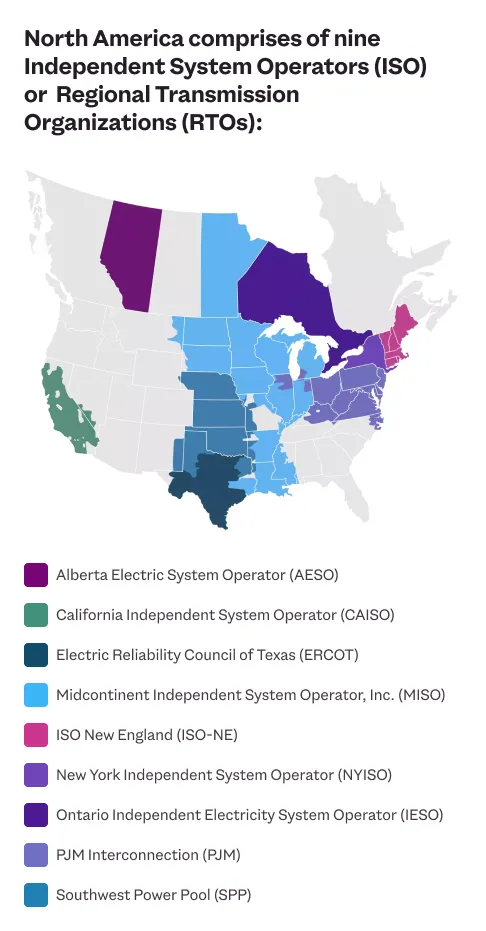
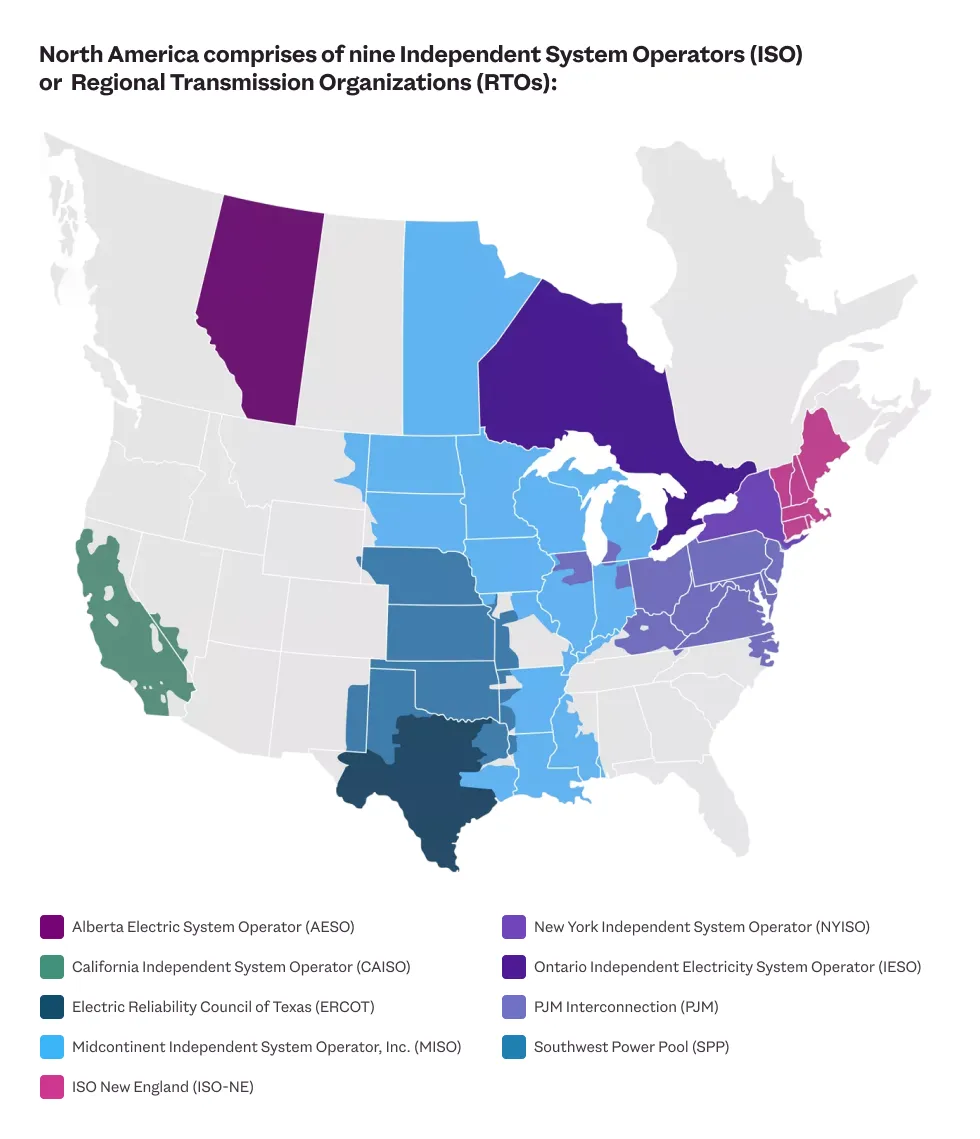
north-american-service-footprint

Day-ahead markets

Day-ahead markets are used to procure electricity for the following day. Market participants submit bids and offers for electricity based on their expected costs and willingness to pay for the following day's electricity supply. The RTO or ISO then matches the bids and offers to determine the clearing price for electricity for each hour of the following day. Day-ahead markets help to ensure that there is enough electricity supply to meet forecasted demand, and also help to reduce the volatility of real-time prices.

Real-time markets

Real-time markets are the most dynamic and volatile markets, where electricity is bought and sold in real-time. These markets operate 24/7 and are designed to manage the real-time balance between electricity supply and demand on the grid. In real-time markets, market participants submit bids and offers for electricity based on their expected costs and willingness to pay. The RTO or ISO then matches those bids and offers to determine the clearing price for electricity in that market. The clearing price is the price that all market participants pay for the electricity they consume during that specific hour.

  • Congestion - The state of high demand for electricity that exceeds the capacity of the transmission system, resulting in delays or disruptions in the delivery of electricity.
  • Capacity - The amount of electricity that can be generated and delivered by the electricity system at any given time.
  • Day-ahead market - A market where electricity is bought and sold for the following day, and the clearing price is determined based on bids and offers from market participants.  This market represents around 95 percent of energy transactions and is based on forecasted load for the next day and typically occurs the prior morning in order to allow generators to prepare for the operation.
  • Distribution - The process of delivering electricity to end-users, such as homes and businesses, through local distribution systems.
  • Electric utilities - public or private entities that own and operate the transmission and distribution lines that transport electricity and supply it to households and businesses.
  • Electricity market - A system that facilitates the trading of electricity between producers and consumers.
  • Federal energy regulatory commission (FERC) – FERC is an independent agency responsible for the regulation of interstate transmission of natural gas, oil, and electricity
  • Generation - The process of producing electricity from a fuel source, such as coal, natural gas, or renewable sources.
  • Grid - A complex interconnected network that generates, transmits, and distributes electricity along 120,000 miles of power lines.
  • Independent system operator (ISO) - A non-profit entity responsible for ensuring the reliability and efficiency of the electricity transmission system and operating various markets that facilitate the trading of electricity.
  • Locational marginal price (LMP) - A pricing system that reflects the true cost of delivering electricity to a specific location on the grid.
  • Real-time market - A market where electricity is bought and sold in real-time, and the clearing price is determined based on bids and offers from market participants.
  • Regional transmission organization (RTO) - A transmission operator that coordinates, controls and monitors an electric grid, and regulated by FERC. It is similar to an ISO and are often referred to interchangeably.
  • Transmission - The process of transporting electricity from power plants to local distribution systems via high-voltage transmission lines.


DA

Day-Ahead

DA-SPP

Day-Ahead Settlement Price Point

ISOs

Independent System Operators

LBMP 

Locational Based Marginal Price

LMP

Locational Marginal Price

RT

Real-Time

RT-SPP

Real-Time Settlement Price Point

RTOs

Regional Transmission Organizations

SPP

Settlement Price Point

Check out our other energy tools

All the energy information you need to stay up to date.

man in blue shirt working at a computer in a modern office with cubicles and colleagues in the background.

See what NRG can do for your business

Our experts will assess your energy situation and uncover your opportunities.

Speak to an expert